ACTEBA Bylaws

Quicksearch

ACTEBA Bylaws


Current as at 1 March
2004
Please
read carefully, ignorance of these By-Laws does not constitute grounds for appeal.
Breaches of these By-Laws will incur penalties at the discretion of the State
Executive Committee.
GeneralSelection
trials
Rule Clarifications
Weekly CompetitionState
of Origin
Meetings
ForfeitsDisputes,
Complaints, and Appeals
Table Specifications
Finals SeriesUmpires
Duties
History (amendments)


GENERAL


1. Unless otherwise specified, all competitions, tournaments and functions
conducted by the ACTEBA will be bound by the Official Rules, Regulations and By-Laws
of the World Eight-Ball Pool Federation (WEBPF), as sanctioned and distributed
by the Australian Eight-Ball Federation, (AEBF). The ACTEBA reserves the right
to amend any, or all, of the Regulations and/or By-Laws, as it sees fit. The ACTEBA
is not restricted to running tournaments that are bound by the Official Rules,
Regulations and By-Laws of the WEBPF. From time to time the ACTEBA may conduct
other tournaments (eg. 9 Ball) for which the official Rules and Regulations will
be specified at the time.

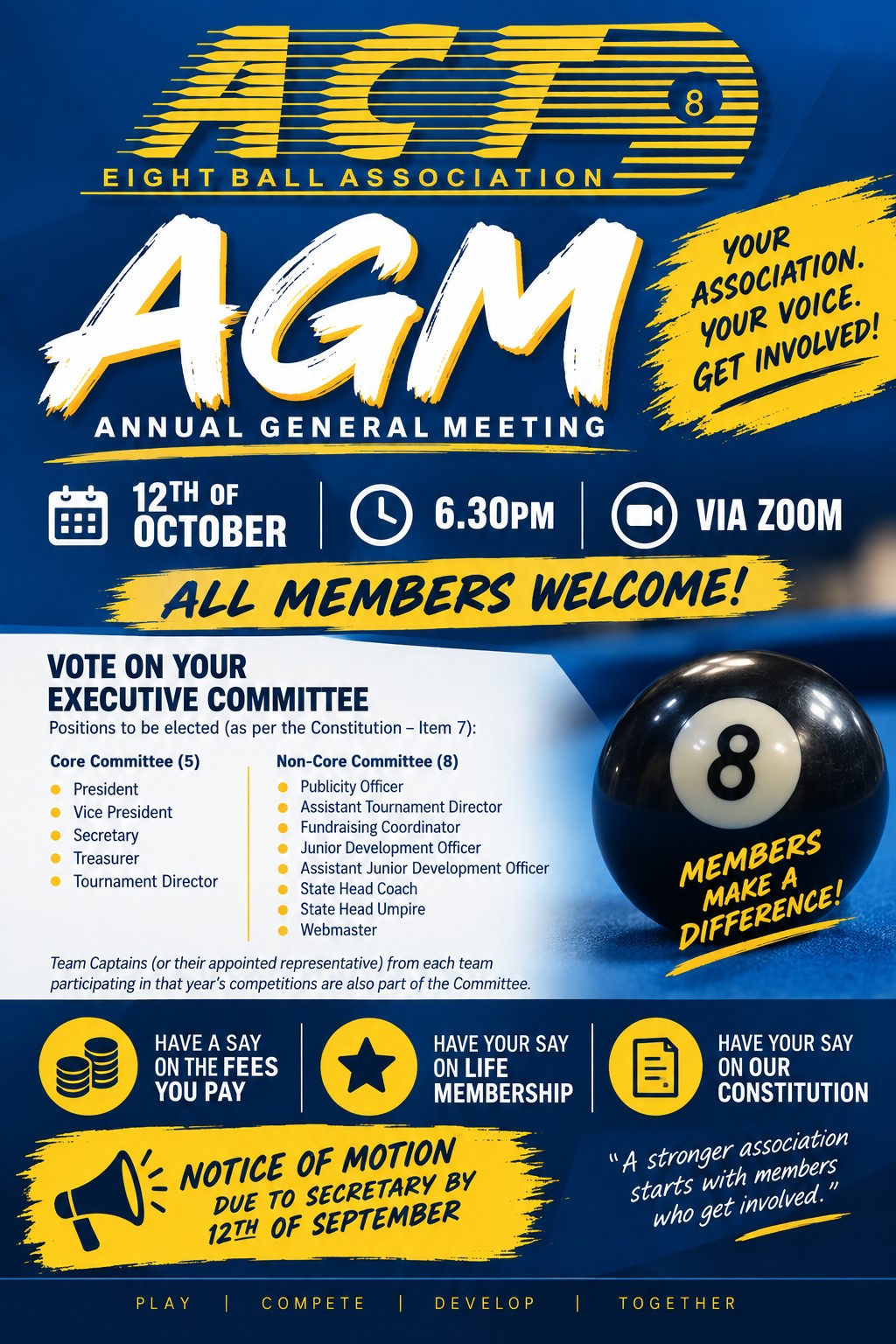
2. The Core Committee consists of the President,
Vice President, Secretary, Treasurer and Tournament Director. The Non Core Committee
is comprised of the Assistant Tournament Director, Publicity Officer, Fund Raising
Coordinator, Junior Development Officer, Assistant Junior Development Officer,
State Head Coach and State Head Umpire. The State Executive Committee comprises
of all the Core and Non Core positions detailed above.

3. Every Player and
Team registered or nominated in any Association scheduled or sanctioned competition,
tournament, or function is expected to conduct themselves in a sportsmanlike
manner
at all times. Unbecoming conduct by word or deed will not be tolerated
and any member of the ACTEBA officially reprimanded under this By-Law may be deemed
ineligible for State Representative Squad selection (refer By-Law 55), and may
have their membership of the ACTEBA revoked, at the discretion of the State Executive
Committee.

4. Players must sit or stand in a neutral position
whilst their opponent is at the table. Players should not engage in communication
(either verbal or non verbal), with persons other than their partner, (in doubles),
the umpire(s), their opponent(s) or a duly appointed ACTEBA official(s), whilst
a frame in which they are participating is in progress. Players requiring a beverage,
pieces of equipment etc, should only acquire such with the prior approval of the
umpire(s) or Tournament Official(s), {see Rules:- (K) Standard Fouls Section (12)}.

5.
Any player(s) barred from entering any venue in which the Association
has a scheduled competition, tournament, or function, should seek special dispensation
from the Proprietor of that venue for the duration of that competition, tournament,
or function. Failure to acquire the special dispensation will result in that player(s)
not being eligible to compete in that competition or tournament, nor attend that
function, for it's duration at that venue. It is the player(s) responsibility,
not the State Executive Committee, to obtain the special dispensation, as required.

6.
There is to be no practice for any player(s) on any tables designated
for the competition or tournament, once that Competition or Tournament has officially
commenced. Any tables not designated for that competition or tournament may be
used for practice. Any player(s) found practicing on designated tables after the
official commencement of the event may be disqualified from that competition or
tournament, {see Rules: - (A) Spirit of the Game}.

7. If a person under
the age of eighteen years is entered in any Association event,
prior approval must be sought from the proprietor of the venue at which the event
is to be conducted. For the weekly competitions, it is the team captains responsibility,
and for State Selection trials, the responsibility rests with the Tournament Director.

8.
The Tournament Director, when seeding ACTEBA sanctioned Tournaments and/or Competitions,
may consult with other members of the State Executive Committee before finalising
the seedings.


WEEKLY
COMPETITION


9. The weekly competition will consist of 24 singles matches,
divided into 4 Rounds of 6 Frames. Each match will require 2 tables, therefore
a venue will require a minimum of two tables for a team to be able to participate
in the weekly competition. A venue can host up to 2 teams for every two tables
under the home-and-away round-robin format of the weekly competition.

10.
Every effort will be made to ensure each competition, (Winter and Summer), will
consist of 2 full rounds. Each team in each grade will play every other team in
their grade once at their home venue, and once at the opposing team’s home
venue.

11. A Team Registration Form, detailing the team
name, players details, (in full), and venue name and address, is required for
each weekly competition. Each team can consist of a minimum of 6 players, up to
a maximum of 9 players. Players joining teams after the lodgement of the team
registration form must be registered with the Tournament Director before playing
their first match, and the applicable fees paid at the next scheduled State Executive
Committee Meeting. If the applicable fees are not paid, all frames played in that
competition will be declared forfeits, and that player declared ineligible to
compete until the outstanding monies are paid. Any frames forfeited will not be
re-instated upon payment of the said fees.

12. The Fees
for the Winter and Summer competitions is $45 per player, per competition. This
fee must be paid no later than the State Executive Committee meeting after round
4 of that competition. Failure to do so will result in unpaid players from that
team being charged a $10 late fee per player. The full fee (ie.
$55 per player) must be paid before the commencement of round 8. Failure to do
so will result in player or team expulsion, with the results from the first half
of the competition to stand. Players will then be declared ineligible to compete
until the outstanding monies are paid.

13. The fees for the Winter and Summer
competitions will be set at the Annual General Meeting. All other fees or levies
will be set at the discretion of the State Executive Committee.

14. Prior
to the commencement of round 3 of a competition, any player registered in a team
may be permanently replaced by another player at no charge. Similarly,
any player registered in a team that has played less than 8 frames in the competition
for which they are registered, may be replaced by another player at no charge.

15.
If a member of a team is to be unavailable for the Weekly Competition, for an
extended length of time, (not less than 4 weeks), but will be returning to resume
at a later date, then a temporary replacement may be used (at
no charge). This temporary replacement may also be in the form of a temporary
transfer, if agreed to by both team captains. Teams wishing to transfer or replace
players must do so prior to the commencement of round 8. Transfers or replacements
after this time must be approved by the state executive committee. (refer also
By Laws 11 and 37)

16. Any team, or player, in the Weekly Competition, that
has outstanding monies owing to the ACTEBA, will have all matches
declared as forfeits, until such time as the outstanding monies
have been paid. Once the outstanding monies have been paid, then that team, or
player, will be eligible for normal points and awards for all future matches,
however any previously forfeited matches will not be reinstated (unless otherwise
directed by the State Executive Committee).

17.
Should a team incur a debt with the ACTEBA and not clear that
debt prior to the conclusion of the event in which the debt was incurred, then
each player registered in that team will become responsible for an equal
share
of the team's debt. Each player will be listed on the Association's
Debtors Register, and will not be permitted to participate in any Association
competition, tournament, or function, until their share of the debt has been paid.
Should a team be able to provide evidence to the State Executive Committee to
the effect that specific team members are responsible for incurring that debt,
then those team members not responsible may be cleared of their obligation with
regard to the team's outstanding debt.

18. Should a team or player submit
a cheque for payment to the ACTEBA, which is subsequently dishonoured,
then that team or player will be required to repay the amount (and any related
dishonour charges) as soon as possible, either by cash or money order. No future
cheques will be accepted from that team or player in relation to the this debt.

19. The weekly competitions (Winter and Summer) will be graded
by the Tournament Director. The winning team from the previous competition in
each grade will be promoted to the next grade, and the last placed team in each
grade will be relegated to the grade below. Teams will then be split into grades,
based on the individual players rankings in each team. The Tournament Director
shall make every effort to ensure there are no less than 6 teams in each grade.

20.
Official Scoresheets should be completely filled in, giving the
full name of each player, (not nick names). Players competing in the Winter and/or
Summer competitions should ensure that they sign at least one of the Official
Scoresheets prior to departure. Any games played by a player who has not signed
at least one of the Official Result Sheets may be declared as forfeits. Matches
are to be played strictly in the order in which they appear on the Official Scoresheet.

21.
Once names on the Official Scoresheets have been exchanged
prior to the commencement of a match, or substitutes exchanged after each round,
further changes can only be made at the completion of each round via a substitution,
except when agreed to by both captains.

22 Teams must submit all Official
Scoresheets for each competition to the Tournament Director, and are encouraged
to do so throughout the competition at the State Executive Committee meetings.
If any team does not submit ALL Official Scoresheets, this will result in no players
from that team receiving any ranking points for that entire competition.

23. The Home Team Captain is responsible for ensuring that the tables to
be used for the match are opened at 7.30pm for free practice
and remain open for free play until the conclusion of that match.
Both captains are required to complete their scoresheets and exchange names BEFORE
8pm, so that play can commence on time.

24. The Home Team Captain is responsible
for ensuring that the tables scheduled for their match are brushed and
blocked
prior to the commencement of competition each night at their
venue. Failure to do so can result in the home team forfeiting the match. For
matches scheduled at neutral venues each team is responsible for brushing and
blocking a table each.

25.
Venues are expected to have available the correct equipment on
competition nights, which includes:

a) ONE REGULATION SIZED CUE BALL,

b) ONE TRIANGLE,
c) ONE TABLE BRUSH,
d) ONE TABLE BLOCK,
e) ONE BRIDGE
FITTING, AND
f) ONE SPIDER FITTING.

Any venue not having the required
equipment available will not be considered as a suitable venue for any Finals
Series matches, nor Selection Trials matches, and may not be considered for any
future competitions until such time as the equipment is made available.

26.
Any venues fielding 2 or more teams in the same grade are advised
that the matches between these teams will be scheduled on, or before, the third
week of scheduled competition, where possible.

27. The Tournament Director
will maintain a list of ACTEBA State Rankings, in a manner determined
by the State Executive Committee. The rankings will be adjusted after the completion
of each weekly competition, with the previous 4 weekly competitions (ie. the previous
2 Summer and 2 Winter competitions) and the preceding 2 State Selection Trials
contributing, plus any other competition the State Executive Committee feels necessary.
The finals series’ of the weekly competitions shall not contribute to a
players ranking (ie. only the preliminary rounds contribute).


FORFEITS


28. If any player plays one or more frames on a night, and must forfeit
a frame
for any reason during the night, that frame shall still contribute
to their rankings. For example, if a player wins 2 out of 3 games and then leaves
early, with no reserve to substitute into the team, that player will be credited
with 2 out of 4 for the match.

29. If a team can only field 5 players
on a competition night, then that team must forfeit 1 frame from each round of
the competition, (i.e. 4 frames out of the total 24). If a team can only field
4 players, then they must forfeit 2 frames from each round, (i.e. 8 frames out
of 24). If a team can only field 3 players, then they must forfeit 3 frames from
each round, (i.e. 12 frames out of 24).

30. If a team has no players
present at the scheduled starting time of 8pm, then that team must forfeit the
match. If a team cannot field a team (ie. they have less than 3 players present)
at 8pm, they may complete an official scoresheet, in the knowledge or hope that
more players will arrive (refer to By-Law 29). If, at 8.30pm, they are still unable
to field a team, then the match is forfeited.

31. The Team Captain is permitted
to place the bye(s) where-ever he/she wishes, (or he/she may
list a player(s), hoping that they will show up late), and the forfeit for that
frame takes effect immediately when the Team Captain places the bye or forfeit
on the Official Scoresheet, or when that player's game is ready to commence and
that player has not appeared at the venue to compete. If both teams must forfeit
frames, due to a lack of players, then the forfeits must be listed last
on the Official Scoresheet.

32. If a team forfeits a match during a Weekly
Competition, then that team will have a 24-0 loss recorded against them. The team
to which they have forfeited will receive 2 points for the win, and their frames
for and against will be adjusted at the end of the preliminary rounds of that
competition, based on the average frame percentage achieved by that team. The
frame adjustment will be determined via the following scale: -

(a) 0% to
54.167% 13 - 11 Win,
(b) More than 54.167 % to 58.333% 14 - 10 Win,
(c)
More than 58.333 % to 62.500% 15 - 9 Win,
(d) More than 62.500 % to 66.667%
16 - 8 Win,
(e) More than 66.667 % to 70.833% 17 - 7 Win,
(f) More than
70.833 % to 75.000% 18 - 6 Win,
(g) More than 75.000 % to 79.167% 19 - 5 Win,

(h) More than 79.167 % to 83.333% 20 - 4 Win,
(i) More than 83.333 % to 87.500%
21 - 3 Win,
(j) More than 87.500 % to 91.667% 22 - 2 Win,
(k) More than
91.667 % to 95.833% 23 - 1 Win,
(l) More than 95.833 % to 100.000% 24 - 0
Win,

33. If a team has a match forfeited by the State Executive Committee,
due to the lack of payment of outstanding fees, then that team will have their
original result for that week(s) changed to reflect a 24-0 loss against them,
but the team(s) which they played in the affected week(s) will receive no
change
to their original result.


FINALS
SERIES


34. The Finals Series in each grade will be conducted using a double
elimination
format, with the top 4 teams competing, (unless otherwise
directed by the State Executive Committee). For weeks 1 and 2 of the Finals Series,
the venue for each match shall be the home venue of the team
that finished higher on the competition ladder after the completion of the preliminary
rounds. If the venue is unsuitable for a Finals Series match (refer By Law 25),
then the match shall be played at a neutral venue.

35. In the situation
where the number of tables in a venue prevents the application of by law 34 (eg
two teams warrant a home final, but the venue only has two tables),
then the team with the highest frame percentage at the end of the preliminary
rounds will be granted use of the tables. The other team may nominate a preferred
venue to the Tournament Director, but must do this no later than the Saturday
before the match is scheduled. If frame percentages are identical, the Tournament
Director shall toss a coin to decide which team is granted use of the tables.

36.
Matches for week 3 of the Finals Series shall be played at a neutral venue, where
possible, and every effort shall be made to play these matches at the one venue.
The venue for the Grand Finals shall be determined at the State
Executive Committee Meeting prior to the commencement of the Finals Series.

37.
Only players who were properly registered in a designated team at least six weeks
prior to the completion of the Preliminary rounds of the weekly competition, can
play for that team during the Finals Series.

38 Both of the Weekly competitions
are trophy competitions with the recipients of trophies to be
at least the winner of each grade (additional trophies may be awarded at the discretion
of the State Executive Committee). A Presentation Night Dinner shall be held annually
after the completion of the Winter Competition. Trophies will be presented for
the previous Summer and Winter Competitions, and any other competitions sanctioned
and approved by the State Executive Committee.

39. If, at the completion
of the preliminary rounds a Weekly Competition, there are teams in equal
positions
in any of the first four places (except a tie for 2nd and 3rd)
on matches won and frame percentages, then a playoff shall take
place to determine final finishing positions. The playoff shall take place on
the Monday prior to the Wednesday commencement of the finals series. The match
shall be played in the format used in finals matches (refer By Laws 9 and 40).

40.
In the event of a tie during a Finals Series match, each team
Captain will list 5 of their players (registered on the official scoresheet for
that night’s match), in any order they wish. Once both captains have listed
their players, 5 additional frames will be played, strictly in the order in which
the players are listed. The additional frames must be included on the final score
when it is passed on to the Tournament Director.


SELECTION
TRIALS


41. State Representative Squad Selection Trials (hereafter referred to as Selection
Trials) must be completed at least 12 weeks prior to the scheduled
commencement of that year's National Championships.

42. Fees for Selection
Trials are set as follows:-

Singles/Teams events - $30 per player per event

Doubles events - $15 per player per event
Masters events - $15 per player
per event
Juniors events - $15 per player per event

43. A nomination
form
for the Selection Trials will not be accepted unless accompanied
by full payment of the associated entry fees (unless otherwise directed by the
State Executive Committee). Similarly, a nomination form will not be accepted
if that member has an outstanding debt to the Association, (refer
By-Law 16)

44. Any Players, Teams, or Venues with outstanding debts at the
completion of a season will be deemed ineligible for trophies
and/or awards, and state representative squad selection. In addition they will
not be permitted to compete in any future ACTEBA sanctioned events,
until such time as the Outstanding Debt has been cleared.

45. The Tournament
Director will seed all players in the first round of all State Championship events.
These seedings will be based on the ACTEBA Ranking System, in conjunction with
recommendations made by members of the State Executive Committee. Once a Championship
and/or Tournament has been seeded then those seedings may be maintained throughout
each subsequent round of the event, (except in the case of a Double Elimination
or Straight Knock-out format in which seedings are only required for the first
round), or may be reassessed by the Tournament Director if deemed appropriate
by that Committee.

46. Each event of the Selection Trials will have a scheduled
Commencement Time. Any player not present at this scheduled Commencement
Time, for whatever reason, will be disqualified from that event, unless prior
approval has been granted by the Tournament Director. In such an event, that player’s
scheduled matches will be recorded as Byes with no results for matches or frames
awarded to any players in that group. Players disqualified under this By-Law have
the right to appeal the decision (refer By-Law 71).

47. Any player(s) who
fails to complete their scheduled frames or matches on any given day of the Selection
Trials (except if By Law 48 applies), will have all of their previous frames/matches
for that day’s play recorded as Byes, as though they didn’t show up
at all (refer By-Law 46). Players who are penalised under this By-Law will be
automatically disqualified from the event and may also be deemed to be ineligible
for nomination in future Selection Trials at the discretion of the State Executive
Committee (refer By-Law 55).

48. Any player(s) who fails to complete their
scheduled frames or matches on any given day of the Selection Trials, but has
played every other player(s) the same amount of frames/matches (e.g. not turning
up to the second day of the top 16 playoff where exactly half of the total frames
were played on the first day), will be disqualified from that event, however the
original results from frames/matches played will stand. Players penalised under
this By-Law may also be deemed to be ineligible for nomination in future Selection
Trials, at the discretion of the State Executive Committee (refer By-Law 55).

49.
To be eligible for membership of the State Representative
Squad
, a member must have participated in at least 33.3% of the total
matches (not including finals), in either of the completed Winter or Summer competitions
that were held immediately prior to the closing date for State Selection Trial
nominations. If a player nominates for the Selection Trials who has not satisfied
these requirements, but is participating in either a Winter or Summer Competition
at the time of nominating, then that member will be deemed eligible for membership
of the State Representative Squad if he/she has participated in at least 33.3%
of that competition (not including finals), by the time the Selection Trials are
completed.

50.
Should junior members of the Association, (under the age of 18
years), be successful in making the Senior State Representative Squad to compete
in the Senior National Titles, then their representation is conditional upon them
being accompanied by a parent, or a designated legal guardian, who is not scheduled
to compete in those National Championships.

51. At the completion of the
Selection Trials, the top eight (8) ladies players and the top ten (10) open players
will be selected in the State Representative Squad.

52. A special “wild
card”
into either the open or ladies State Representative Squad
shall be granted to any player(s) selected in the Australian 8 ball team, and
is unavailable to compete in the Selection Trials due to representative duties.
If this situation arises, then other squad members shall be selected to take the
numbers up to 10 (Open) or 8 (Ladies). For example, if two Open players are in
this situation, then the top 8 from the Selection Trials will be selected to join
these two in the Open State Representative Squad.

53. If By-Law 52 applies,
the player(s) involved shall also be given the same rankings points
as the previous years Selection Trials for any event that the player(s) is unable
to contest. This could be the singles event, the doubles event, or both.

54.
All players who are successful in making the State Representative Squad must pay
a deposit of $300-00 to the Association within one month of their notification
of their selection in the squad. Failure to comply may result in their being replaced
by the first available reserve. Any reserve called into the State Representative
Squad will have 2 weeks, from the date of notification, to pay their $300-00 deposit
to the Association.

55. Any player(s) officially reprimanded
for misbehaviour, misconduct, or ‘causing trouble’ during the course
of any ACTEBA sanctioned event may be considered ineligible for selection in the
State Representative Squad.

56.
All members of the ACTEBA who are successful in making the State Representative
Squad must sit and pass the relevant umpires exam (as directed
by the State Executive Committee), prior to their being eligible to participate
in the National Championships. Failure to comply may result in their disqualification
from the State Representative Squad for that year, and may also deem them ineligible
for selection in future years, at the discretion of the State Executive Committee.

57.
Any player selected for the State Representative Squad who becomes unavailable,
or who does not conform to the standards set by the State Executive Committee,
will be replaced by the first available reserve. Reserves may
only be selected from players who finished in the top 16 positions in any Selection
Trials event (unless otherwise directed by the State Executive Committee).

58.
All Captains, Vice Captains, Managers and any other positions of the State Representative
Squad, as deemed necessary by the State Executive Committee, will be appointed
by the State Executive Committee
. The State Executive Committee may call
for nominations for these positions and will appoint people to these positions
by way of a majority vote at a State Executive Committee meeting. The State Executive
Committee is not necessarily restricted to any nominations received, and may appoint
members to these positions at its discretion. The positions of Captain and Vice
Captain are however, restricted to members of their respective teams/squad.

59.
The State Executive Committee will set a "cut off" date for ACTEBA funding
of the State Representative Squad and each Squad members share of the available
funds will be determined at this time. Should any additional funds be forthcoming
after this date then reimbursement to State Representative Squad members will
occur upon their return from the National Championships, with the allocation of
these additional funds to be at the discretion of the State Executive Committee.

60.
Funding for the State Representative Squad each year will consist
of twenty percent (20%) of that years Summer and Winter Competitions player registration
fees (including late fees if applicable), all entry fees collected from that years
State Selection trials (excluding 9 ball events) and any fund raising or sponsorship
organised for that years State Representative Squad.

61. At the discretion
of the Tournament Director, a list of members who have put in extra effort to
assist the running the Selection Trials, or have contributed sponsorship to any
event, will be presented to the State Executive Committee. The State Executive
Committee may reward these members for their efforts with free entry into the
following years selection trials (Open Teams event only). Core committee members
are granted an exemption for ALL state selection trials entry
fees. This exemption is not automatic, but may be invoked whenever a core committee
member wishes.


STATE
OF ORIGIN


62. The State of Origin series between North Canberra and
South Canberra will consist of one match for each division. The lowest division
match will be first, followed by the 2nd lowest division and so on until the 1st
division match. Each match will consist of 32 frames, divided into 4 rounds of
8 frames.

63. Players are selected to represent each zone from the ACTEBA
State rankings determined after the completion of the previous years competitions.
The top 10 ranked players from each division are selected to represent their zone.
Nominations will be called for the position of team captain for both zones and
this will be voted on at a preceding State Executive Committee meeting. To be
eligible to compete, a player must be a registered member of the association,
and must not have any outstanding monies owing to the association.

64.
Each team will contain a minimum of two female players, if available. If there
is only one female in the top 10 ranked players, then the top 9 and the next highest
ranked female is selected. Every player must play at least two frames of the match.

65.
The team with the highest aggregate frame count over the three matches (ie. a
total of 96 frames) will be declared the winner. In the event of a tie, the zone
who won the series the previous year will remain holders of the trophy.

66.
Members of both teams will be presented with medallions on Presentation Night,
and a trophy awarded to the victorious captain. Every effort should be made to
have the trophy displayed at one of the venues of the victorious zone.

67
In deciding the venues selected to host the series, every effort
will be made to allocate one venue to the current holder of the trophy and two
venues to the other zone. (ie. if North Canberra hold the trophy, the first match
will be in South Canberra, the second in North Canberra and the third in South
Canberra).


DISPUTES,
COMPLAINTS and APPEALS


68. In the case of a dispute pertaining to a frame in progress
the following procedure must be followed, prior to the continuation of play: -


(a) The player must approach the umpire(s) and dispute the call, (or lack there
of),
(b) If the umpire will not reverse their decision then the player may
ask permission from the umpire to call in their team captain, (if an umpire calls
in a team captain then he/she must also call in the other team captain),
(c)
In the event that a team captain is involved in the dispute or is otherwise unavailable
at the time, then the player involved in the dispute (who is either the captain
or whose captain is unavailable) may designate another team member to act as captain
for the purposes of resolving the dispute.
(d) If both team captains and the
two (2) umpires cannot reach an amicable decision, then a member of the State
Executive Committee should be called for adjudication, (1st - State Umpire, 2nd
- Tournament Director, 3rd - President, 4th - Vice President and, lastly, anyone
else on the State Executive Core Committee).
(e) If a decision still cannot
be reached then the game is declared a "No Result", re racked and replayed,
with the same player to break.

DISPUTES LODGED AFTER THE CONTINUATION OF
PLAY CANNOT EFFECT THE RESULT OF THAT GAME UNLESS IT RELATES TO AN UMPIRES CALL
(See By-Law 81).

69. Captains and/or team members are not
to enter into a dispute, unless requested to do so by the umpire(s) and/or Tournament
Official(s). Players may request, (through the umpire(s) and/or Tournament Officials),
for their captain to be called in, but only prior to the next shot. Any captain
and/or team member entering into a dispute, or entering the playing area during
a dispute, without the express permission of the umpire(s) and/or Tournament Officials
will draw a foul against the player from their team, (regardless
of the nature of the dispute), and the opposing player will receive 2 visits.

70.
Teams or Players may register a complaint against an opposing
team or player or against a venue (eg. for unsportsmanlike behaviour or unsuitable
facilities), or against any scheduled Association Competition, Tournament or Function.
The complaint must be made to a member of the State Executive Committee verbally
within 48 hours of the incident, and must then be formalised in writing
within 7 Calendar days, and forwarded to the State Executive Committee for deliberation.
Any decision made, or penalty imposed, by the State Executive Committee will be
final and no further correspondence will be entered into (except if By Law 71
applies).

71. Any Team, Player, or Venue may appeal any
decision handed down by the State Executive Committee, providing that the Appeal
is submitted in writing to the State Executive Committee, within 7 Calendar days
of the receipt of the notification of the decision. All appeals must be based
on new evidence not previously presented to the State Executive Committee. If
the State Executive Committee agrees that an appeal should be heard, then this
shall take place at the next scheduled State Executive Committee meeting.


UMPIRES
DUTIES


72. During the regular weekly competition two umpires will
control each frame in a match, however only one of the umpires will be designated
the extra duty of timekeeping. Each team shall supply one umpire to both tables,
for the duration of the match. The team captains will agree to designate the table
for which they must allocate an umpire who will also act as timekeeper. The captains
may agree, prior to the commencement of a match, to have each match controlled
by only one umpire, who would also be responsible for timekeeping.
In this case however, both captains must be in agreement, otherwise the requirement
for two umpires will remain in force. Failure by a team to fulfil their umpiring
obligations for any frame will result in that team forfeiting that frame, and
any subsequent frames, until the umpire is supplied (unless prior arrangements
have been made between the opposing captains).

73. The Umpire shall answer
all questions from players as outlined in the Official Rules,
{see Rules:- (Z) Referees Guidelines and Duties Section (2)(a)(2)}. If the Umpire
has any doubt concerning the legality of a players query then they should confer
with the other umpire, if in use, otherwise a team captain, for clarification
prior to advising the player. If the umpire(s) deems the players query inappropriate
then they should advise the player that they decline to answer the query as it
may be deemed as Coaching and, therefore not in the spirit of the game.

74.
As soon as a foul occurs the umpire must announce "Foul
- two visits to team A", or "Foul - one visit to team A". The umpire
should not wait until the balls come to rest before making a foul
call. An umpire may call more than one foul on a shot however the penalty imposed
must be the one relating to the most serious infringement called.

75.
When the player has completed the first visit after a foul, the umpire must announce
"Second visit", or "One visit remaining". When the player
has completed the second visit, the umpire says nothing – the onus is on
the player to be aware of the state of the frame. If the player addresses the
table for a third visit a foul must be called as soon as they touch the table
(after the 10 seconds has passed), and two visits awarded to the opposing player,
{see Rules (K) Standard Fouls (10)}.

76. When an umpire makes a "30
second warning"
or a "One visit remaining"
call, they should move towards the table and raise an arm in the air, to indicate
to the players that a call has been made.

77. The umpire is obligated to
call a "Touching ball" when the situation arises, but
is not obligated to call a "Frozen Ball",
however the umpire must be aware of the situation. A player cannot be fouled under
the "Touching ball" rule, {see Rules (T) Touching Balls}, if the umpire
has not made the effort to ascertain whether or not the cue ball is touching.
Similarly a player cannot be fouled under the "Frozen ball"
rule, {see Rules (G) Legal Shot}, if the umpire has not made the effort to ascertain
whether or not an object ball is frozen on a cushion. It is always in the players
best interest to ask the umpire, prior to playing a shot, if a ball is touching
or frozen.

78. It is in the umpire’s own interest to ensure that a
"Block Warning"
is issued at the commencement of each match,
with regard to coaching.

79. If an umpire is unsure as to whether or not
a foul was committed then the benefit of the doubt must be given to the player
in control of the table. If there is any doubt whatsoever in
the umpire’s mind, then no foul should be called.

80.
If two umpires are in use, one umpire cannot overrule the decision
of the other, (except in the case of a Head Adjudicator). However, ‘time
out’ may be called by either umpire or player, allowing the umpire to confer
on the decision. The umpire may, if he/she wishes, change their decision prior
to the resumption of play.

81. If an umpire admits to an incorrect
call
, or the umpire call is proven to be incorrect then,
if the condition of the game has not changed, the correct call should be made
and play allowed to continue. If the condition of the table has changed when the
incorrect call is admitted or proven, then the game should be declared a "No
Result", re-racked and replayed, with the same player to Break.

82.
If an umpire needs to retire during the course of a Game or Match they must call
for a ‘time out’. The umpire must notify all players
involved, and that umpire’s Team Captain must find a replacement umpire
prior to the resumption of play. All players involved in that Game or Match must
also be notified of the replacement umpire.

83. Umpires should refer to
the Rule Clarifications section of these By Laws, or the rules, (see Rules:- (Z)
Referees Guidelines and Duties), for a more detailed outline of their duties.

84.
Umpires are required to familiarise themselves with the situations under which
they can award an additional visit, or disqualify a player from a game or Match,
under the "Spirit of the Game" rule. Every incident where a player is
fouled or disqualified under this rule is to be advised to the Tournament Director
or State Head Umpire within 24 Hours of the infringement, and that umpire may
be required to provide a written statement pertaining to the events that led up
to the call. Any player fouled or disqualified under this rule has the
"Right of appeal"
, as outlined in these By-Laws, (see By-Law
71).

85. A player dismantling their cue during the course of a game does
not automatically lose that game. However if, in the opinion of the Umpire, a
player dismantles their cue towards the end of a frame in a deliberate attempt
to put their opponent “Off”, then they may be fouled
under the “Spirit of the Game” rule and the game awarded to their
opponent.


RULE
CLARIFICATIONS


86. If the cue ball is potted on a "Fair Break" it is a non-standard
foul
, with control of the table passing to the opponent, however the
opponent does not receive an additional visit to the table (that is, the opponent
has only one visit). If the cue ball remains "off the playing surface",
is "double struck" by the cue, or is fouled in any other way other than
being potted, it is a standard foul, with the control of the
table passing to the opponent and the opponent receiving two visits.

87.
When timing a player the time commences once all the balls have
come to rest {see Rules:- (I) Time Allowed Section (2)}. When the cue ball is
potted the timing commences when the cue ball is replaced on the edge (or top)
of the table by the umpire(s), or when the cue ball is handed to the incoming
player. The departing player has 10 seconds to leave the immediate vicinity of
table to the satisfaction of the Umpire(s), {see Rules: - {K) Standard Fouls Section
(11)}. The incoming player gains control of the table as soon as the balls have
come to rest from the preceding shot, {see Rules: (C) Definitions section (9)}.
Therefore it is possible to have 2 players in the playing area
at the same time, (until the 10 seconds has elapsed).

88. During the 10-second
interval when the outgoing player is leaving the table and the incoming player
approaching, both players are allowed to touch the table. Once
the 10 seconds has elapsed the outgoing player would then be fouled. Outgoing
players are allowed to address the cue ball for another visit within this 10 seconds,
however once the 10 seconds is up, or the cue ball has been struck, the outgoing
player would then be fouled {see Rules:- (K) Standard Fouls Section (10) Touching
the table when not in control of the frame, and Rules:- (M) Serious Fouls Section
(1) Playing a shot out of turn}.

89.
When the cue ball is touching 2 object balls of the players own
combination the player can nominate one of those object balls as the Touching
Ball, then fire directly at the other object ball. A cue ball can only be deemed
to be touching one object ball of a player’s own combination. {see Rules:
- (T) Touching Balls section (2)(D)(i)}. Similarly, when the cue ball is touching
an object ball of the player’s own combination and also an object ball of
their opponents combination then the player is deemed to be Touching the object
ball of his own combination and can fire directly into their opponents ball without
penalty.

90. Any ‘time out" granted by an umpire
shall be under the proviso that, in the umpire’s good judgment, the player(s)
are not abusing the privilege as a means of unsettling their opponent(s). All
time outs granted are at the discretion of the umpire, {see Rules:- (I) Time Allowed
Section (5)}.

91. When playing from baulk the cue ball is deemed to be "in
hand" until it is struck by the tip of the cue. Therefore any situation which
permits the cue ball to be played from baulk by the incoming player, will carry
over to the opposing player should a foul occur prior to the cue ball being struck
by the tip of the cue.

92. The "playing area"
is the area immediately surrounding the table upon which the Frame or Match is
being played, as determined by the umpire(s).

93. In the event of a player
accidentally moving an object ball with the Spider or the Bridge,
a Standard Foul must be called, unless caused by an "Act of God", {see
Rules:- (R) Interference Section (1)(C)(i)}.

94. When determining a Foul
Snooker
the straight sections of the cushion are to be ignored, (i.e.
if a player could hit the side of one of his combination of object balls if the
straight section of the cushion was not there then it is not a Foul Snooker).
When determining a Total Snooker the straight sections are to
be taken into consideration, (i.e. if a player could not hit the side of one of
his combination of object balls because of the straight section of the cushion,
then it is a Total Snooker).

95.
During a doubles match both players of a partnership are deemed to be in
control
of the table when it is their team's visit to the table. Therefore,
either player of either partnership may converse with their partner at any stage
of the frame, even whilst either player is touching the table. Only the player
who's turn it is to shoot, may strike the cue ball. Should the partner of the
player who's turn it is, strike the cue ball a foul will be called immediately,
{see Rules: - (M) Serious Fouls Section (1)}. If a player is coaching his/her
partner, (i.e. placing his finger on the cushion to indicate where the cue ball
should strike it, whilst his partner is actually playing the shot), the player
may be fouled, {see Rules: - (K) Standard Fouls Section (12)}, at the discretion
of the umpire(s).

96. During a doubles match, whilst both players are entitled
to touch the table, if one partner assists the other partner in the actual playing
of the shot, they will be Fouled for breaching the "Spirit of the Game",
and the game awarded to the opponents.


MEETINGS


97. A regular meeting of the State Executive Committee, (hereafter referred
to as a State Executive Committee Meeting), will be held on the first Monday of
every month, (unless otherwise directed by the State Executive Committee). Each
“Core” Committee member is entitled to cast 2 votes on any issues
raised at these meetings and put to the vote. Each “Non Core” Committee
member is entitled to cast 1 vote on any issues raised at these meetings and subsequently
put to the vote. (Refer By-Law 2)

98. Any person attending a State Executive
Committee Meeting in a multiple capacity, (i.e. as an “Core” Committee
member and as a Team Captain), is entitled to the voting rights of both positions,
so in the example listed this person would be entitled to cast 3 votes personally.

99.
Each team is requested to ensure that they have at least 1 representative at each
meeting. If the Team Captain is unable to attend then they may pass their voting
rights, via proxy, to another team member, or to any other member of the Association.
Whilst the Team Captain is the only member of the team entitled to vote at State
Executive Committee Meetings, (in person or by proxy), any member of the team
may attend as an observer. Every team that is represented in person by a team
member at a State Executive Committee Meeting will receive one (1) additional
point towards their match point score for the current season. Only 1 point may
be awarded to any one team from any one meeting, and only State Executive Committee
Meetings scheduled under By-Law 98 are applicable. The bonus point will
only be awarded to teams that are represented within at least 30 minutes of the
commencement of the meeting, and are still represented after the vote on the final
motion of the meeting
.

100. Any member continuously speaking out
of turn or ‘shouting people down’ during State Executive committee
meetings will be issued with a warning. If that person requires a second warning
they will be asked to leave the meeting. If a person is asked to leave a State
Executive committee meeting, they will automatically be banned from attending
the next two state executive committee meetings.

101. In addition to an individuals own member vote at an Annual General Meeting,
they may hold a maximum of 8 proxy votes from other members of the Association.
This means that each member can hold a maximum of 9 votes for the AGM.


TABLE SPECIFICATIONS


102.
For competition the table should be 2133.6mm x 1066.8mm, (7' x 3'6"), with
50.8mm, (2") Numerical Object Balls (or red and yellow balls), and a 47.5mm,
(1-7/8"), Cue Ball.

103. The Baulk Line should be
a straight line drawn from cushion to cushion, Parallel to, and one fifth of the
length of the table from, the face of the cushion that is the greatest distance
from the Triangle Spot, (see By-Law 104).

104. The Triangle
Spot
should be marked at the position where a straight line drawn diagonally
from the centre of a side pocket to the centre of a corner pocket on the opposite
side of the table would intersect with a straight line drawn diagonally from the
centre of the other side pocket to the centre of the other corner pocket at the
same end of the table.

105. The Jaws of the Pockets should
not exceed 2-7/8" in opening.

106. The Height of the
table should not vary from between 85 - 90 Centimetres.

107. The Table
Lights
should be located approximately 800mm above the level of the bed
of the table.

Any of these By-Laws are subject
to variation by the State Executive Committee.
Written application for variation,
or inclusion, will be considered.


History

Amendments
were made to the By-Laws at the State Executive Meeting on 6 February 2001.

The
ACTEBA By-Laws were then given substantial amendment and were approved as a whole
at the State Executive Meeting on 3 February 2003. A major change was the insertion
of a new section for the State of Origin series.

By Law 52
was inserted after the State Executive Meeting on 3 March 2003.

By Law 53
was inserted after the State Executive Meeting on 7 April 2003.
By Law 57
was inserted after the State Executive Meeting on 7 April 2003.

By Law 28
was inserted after the State Executive Meeting on 7 July 2003.
By Laws 34
to 36 were amended/inserted after the State Executive Meeting on 7 July 2003.

By
Law 27 was inserted after the State Executive Meeting on 4 August 2003.

By
Laws 21 and 23 were inserted on 1 March 2004.
By Law 58 (state doubles representatives)
was deleted on 1 March 2004.
By Law 60 was inserted on 1 March 2004.
By
Laws 61 and 62 were amended on 1 March 2004.
By Laws 94 and 95 (balls falling
in without being hit) was deleted on 1 March 2004.

By Law 23 was amended
after State Executive Meeting on 2 August 2004
By Law 101 was inserted after
State Executive Meeting on 2 August 2004

Socialise!

Poll:

Do you vote on the poll?
Yes
No
No.. wait, whut?

Archives